
Build the intelligence layer before the first commercial plant.

As Paebbl scales carbon mineralisation from lab trials to continuous production, it is building the physical operation and its intelligence layer together–so every run can improve the next decision.
Carbon mineralisation at industrial scaleAI-native data foundation
The starting position
The intelligence layer is part of the plant.
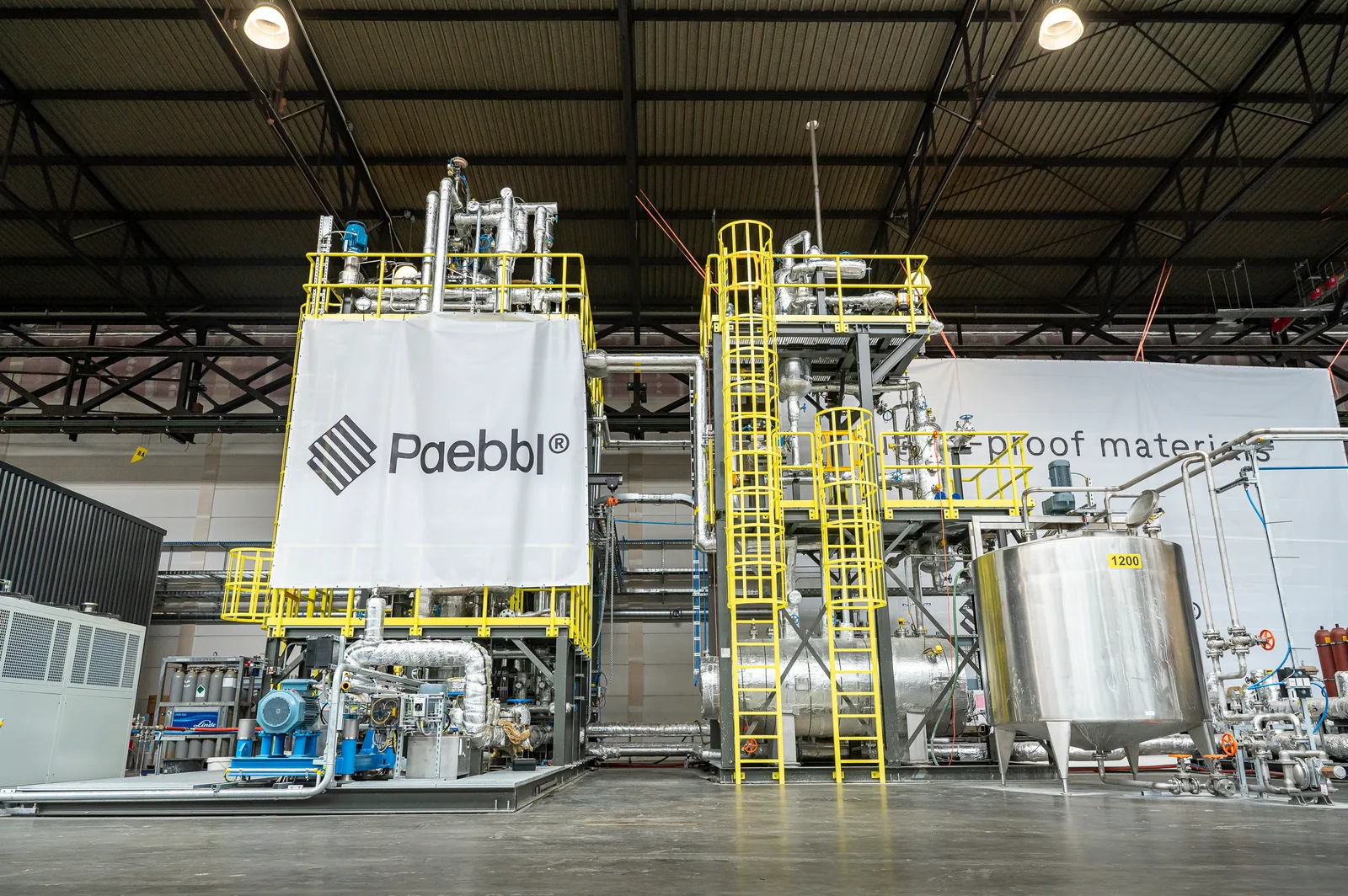
Paebbl has scaled its carbon mineralisation technology 2,500 times in two years, from early lab trials to a continuous demo plant. That pace makes learning a core operational capability: every run should leave the company better prepared for the next one.
The team made deliberate choices about data architecture, learning loops, and data sovereignty from the beginning. Instead of treating AI as a later software project, Paebbl and Ronja built the data foundation alongside the industrial process.
The aim is an intelligence layer Paebbl can own–built on interoperability rather than dependency, and capable of accumulating operational context without locking the company into one model or interface.
- 01Every run
Operational readings, lab results, and customer specifications enter the same governed foundation.
- 02Shared context
Sources, definitions, calculations, and decisions remain connected instead of being reconstructed by hand.
- 03The next decision
Engineers can question the operational history and reuse what the company has already learned.
What changes in practice
A plant that learns from every run.
The foundation turns years of operational history into something people can question, verify, and carry from one team or facility to the next.

Other companies spend years cleaning legacy data before AI can touch it. We built ours AI-ready from day one. Any engineer can query our full operational history in seconds. That is a fundamentally different starting position.
- 01
Operational history becomes queryable.
A process engineer can connect reactor pressure, lab results, and customer specifications without first stitching together exports. The investigation begins with the question, not the preparation work.
- 02
Answers carry their source.
The result is not an isolated answer. People can trace a number through its calculations and back to the underlying source, while missing data and quality issues remain visible.
- 03
Context moves with the team.
When an engineer in Rotterdam discovers something, colleagues in Stockholm and London can use that learning without rebuilding the analysis. New team members can reach the same governed answers as the people who built the demo plant.
The partnership
ROI first. Trust earned. Expand from there.
Paebbl and Ronja aligned on a practical starting principle: build real value fast, prove the first use cases, and avoid announcements that never become operating results.
The partnership was structured around ROI from the beginning. Each proof point created the confidence to widen adoption, and Ronja has become a core tool for a growing number of people across the Paebbl team.
- 01First use case
Start with a concrete operating need.
- 02Proof point
Show value in the work, early.
- 03Team adoption
Make the result useful beyond one specialist.
- 04Next use case
Expand from earned trust.
What the team notices
- Delivery pace
- User feedback can become meaningful product improvements in days, sometimes hours.
- Traceability
- People can follow a number through each calculation and back to its source.
- Usability
- Conversational access lets people focus on what the data is telling them.
Interoperability over dependency
Own the intelligence layer.
Paebbl owns the connections, accumulated context, and workflows that make the layer valuable. The architecture is model-agnostic, so a stronger model can improve the experience without forcing the company to migrate its knowledge or rebuild the foundation.
That sovereignty matters because the intelligence layer is not a sidecar to the operation. It is how learning compounds as Paebbl moves from a continuous demo plant toward commercial scale.
Read the original news story

From the first proof point
Ronja aligned with us on the fundamentals: build real value fast, no early announcements that never show results. The partnership was structured around ROI on the first use cases, so we could see proof points quickly, build trust, and go from there. Today Ronja is a core tool for a growing number of people across the Paebbl team.
Build from the data your operation already creates
What could your next run teach the one after it?
Start with one valuable operating question. Prove the result, then build the next use case on the same foundation.