
Most industrial companies spend years bolting AI onto systems that were never built for it. One Swedish carbon-tech scale-up, working with Ronja, did the opposite: it built a self-learning plant from day one, on an AI-native data foundation. It may signal where all of industrial AI is heading.
Every run makes the next one better.
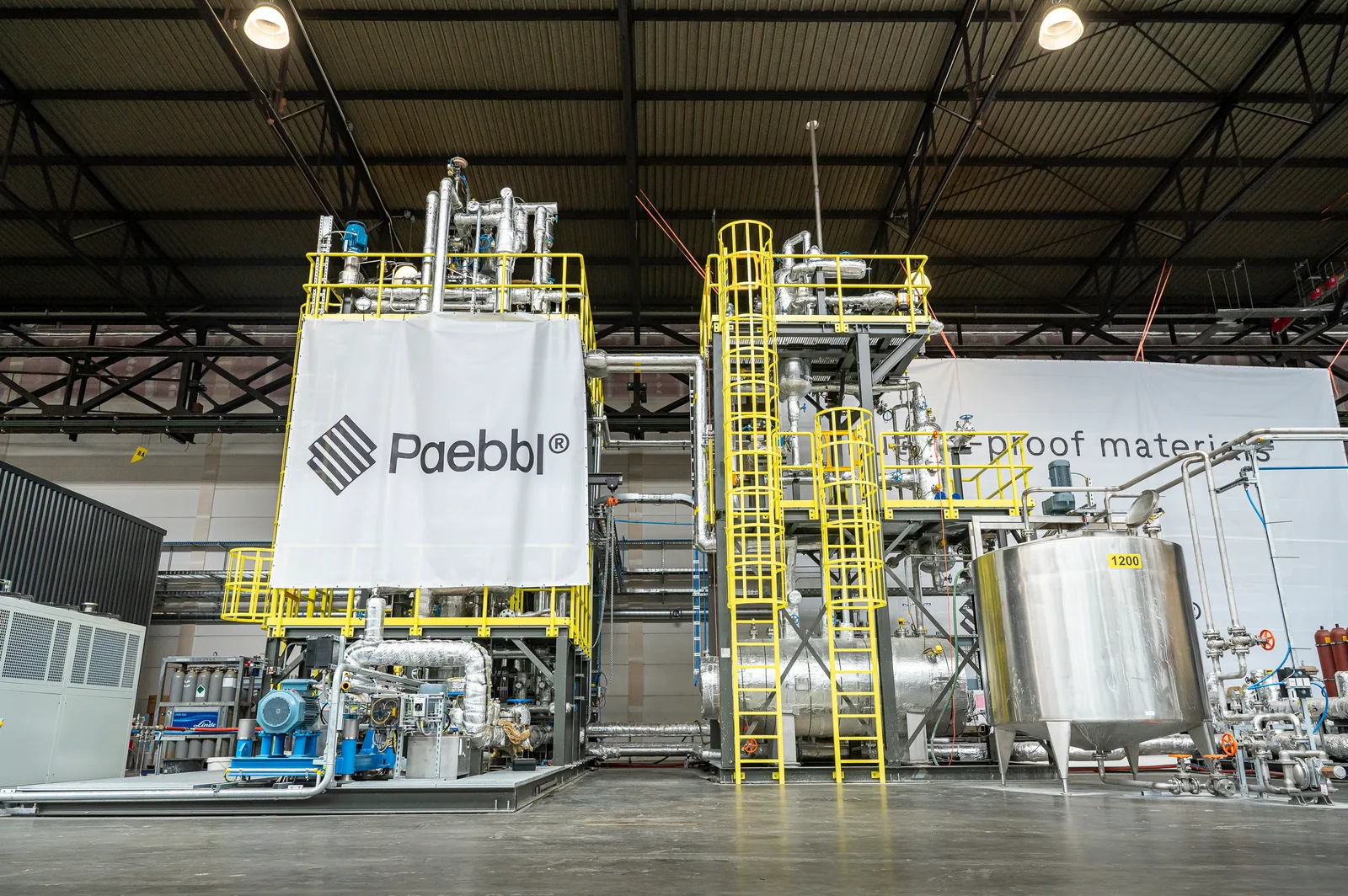
That is the core idea. In Rotterdam's port district, a reactor mineralises captured CO2 into a stable mineral powder that replaces cement. Every pressure reading, every temperature curve, every lab result feeds an AI layer that improves the process in real time. Not in six months when someone builds a dashboard. Now.
The company is Paebbl. They have scaled their carbon mineralisation technology 2,500x in two years, from early lab trials to a continuous demo plant. Fernando Sosa, formerly Tesla, is now leading the build of their first commercial-scale plant. But the less obvious bet may be the more consequential one: the AI layer running underneath all of it, built with Ronja.
AI from day one, not year five
Most manufacturers inherit decades of disconnected data systems. Spreadsheets, siloed databases, tribal knowledge locked in people's heads. Then they try to retrofit AI on top. It rarely works well.
Paebbl skipped that entirely. From the first reactor run, every data point has fed a single AI-native layer, built together with Ronja. The result: a plant that accumulates intelligence with every hour of operation.
“Other companies spend years cleaning legacy data before AI can touch it. We built ours AI-ready from day one. Any engineer can query our full operational history in seconds. That is a fundamentally different starting position.”


Why this matters right now
Industrial AI is the most talked-about transformation in manufacturing. But the gap between ambition and reality is enormous. Most deployments stall because the data foundation was never designed for it.
Paebbl represents a new pattern: companies that build the physical operation and the AI layer simultaneously. No legacy to work around. No multi-year data cleanup project. The learning starts on day one and compounds from there.
“The companies that change the future find ways to accelerate disproportionately in the age of AI. For Paebbl, that means turning every reactor run into knowledge for the next one, at a pace legacy systems simply cannot match.”

What it looks like in practice
A process engineer correlating this morning's reactor pressure with last week's lab results and a customer's quality specs does not stitch it together by hand. It is a question. The answer traces to the source.
- Missing data surfaces automatically.
- Quality checks run around the clock.
- When an engineer in Rotterdam discovers something, colleagues in Stockholm and London have it the same day.
- A new hire gets the same governed answers as the team that built the demo plant.
No lock-in. The AI layer belongs to Paebbl
One deliberate choice: full sovereignty. Paebbl owns its connections, its accumulated context, its workflows. Ronja is model-agnostic. When a stronger model ships, Paebbl benefits the same day. No migration. No rebuilding. No lost knowledge.
The signal
Paebbl is not running a pilot. They are delivering real products to real customers, from Rotterdam to La Réunion, while scaling toward a commercial plant. The fact that they built the AI brain before the commercial facility, not after, is the pattern to watch.
The plant that learns. Every run makes the next one better.